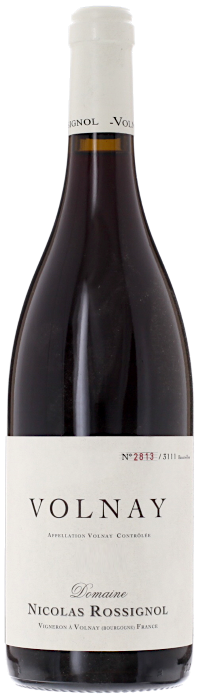
VOLNAY
2021 Domaine Nicolas Rossignol
| Grapes | Pinot Noir |
| Colour | Red |
| Origin | France, Burgundy |
| District | Côte d'Or |
| Sub-district | Côte de Beaune |
| Village | Volnay |
| ABV | 13% |
The 2021 Volnay from Domaine Nicolas Rossignol is a masterclass in transparency, reflecting a cooler, more traditional Burgundian vintage. Sourced from a blend of lower-slope plots (Les Buttes, Les Grands Champs, Les Famines, and Les Lurets) characterized by clay and chalk-limestone soils, the wine is built on a framework of ethereal red fruit and crystalline acidity. The nose is high-toned, bursting with crunchy red cherry, pomegranate, and peony, underscored by a distinct flinty mineral streak. On the palate, it is lean and vibrant rather than broad. The tannins are chalky and fine-grained, a result of Rossignol’s "infusion" approach to extraction. The finish is saline and remarkably fresh, making it a superb candidate for early enjoyment or cellaring through 2026–2038. L&S (May 2026)
| 12 | ||
DELIVERY SERVICE
We offer free nationwide delivery on all orders over £150 (excluding Highlands & Islands). Express Delivery options also available.Technical Profile Viticulture: Grapes are hand-harvested into small 8kg crates to prevent premature crushing and oxidation. Vinification: Following a rigorous double sorting, fermentation occurs via indigenous yeasts. Rossignol typically destems with berries left intact to preserve fruit purity, though some whole-cluster may be used depending on stem ripeness. Elevage: The wine is moved into barrel by gravity and aged for 10 to 20 months in French oak. In 2021, the new oak proportion was kept modest (typically 10–20%) to respect the delicate vintage character. Unique Protocol: A signature of the Domaine is delayed malolactic fermentation (often by six months), which preserves aromatic tension and structural precision. The wine is aged on its fine lees without racking until bottling. Finishing: Bottled unfined and unfiltered, maintaining the wine’s natural texture and vitality.
Domaine Nicolas Rossignol
Born in 1974, Nicolas represents the fifth generation of his family in Volnay (a village which seems to be populated almost entirely by families with Rossignol somewhere in the name). He started to make the wines of his 'Rossignol-Jeanniard' family domaine when he was just twenty.
After studies at the Lycée viticole in Beaune, he worked with Joseph Voillot in Volnay, who became a mentor to him, for Louis Latour at their estate in the Ardèche, and for Vieux Télégraphe on Châteauneuf, where he loved the combination of richness and elegance in the wines, which influenced the style of wines he would later want to make himself. He also made wine in Boschendal in South Africa, and for Château la Cardonne in Bordeaux (then managed by the Lafite team).
In 1997, Nico started his own domaine with three hectares of vines inherited from an uncle. After a period in which some of the wines he made were labelled 'Domaine Rossignol-Jeanniard', and some 'Domaine Nicolas Rossignol', he began to buy the fruit from his (Rossignol-Jeanniard) family, and label these simply 'Nicolas Rossignol' (without the 'domaine'). Now the vines (all 16 hectares) are finally in the 'Domaine Nicolas Rossignol', and labelled as such. To handle this sizeable domaine, Nico needed a new winery. Having started with a chaotic assemblage of tanks in a building in the village of Volnay, he had moved to share Ben Leroux's winery on the Beaune ring road, but Nico had dreams of his own place and built his impressive new winery in 2016. A fantastic bespoke build, admittedly in a ZI (Zone Industrielle) on the outskirts of Beaune, which he recognises is not ideal for the 'folklore' aspect, it is a perfect tool for the job, and does have a good view of all 'his' bits of the Côte - from a sort of eyrie on the roof.
Like many Burgundy domaines, the appellations have proliferated as the surface area of the vineyard has increased with lots of little (and some quite large) parcels of vines in Aloxe ('village'), Savigny ('village' and two Premiers Crus), Beaune (three Premiers Crus), Pernand ('village' and one Premier Cru), Pommard (three 'village' wines and six Premiers Crus) and Volnay ('village' and seven Premiers Crus). With two cuvées of Bourgogne Rouge, this adds up to twenty-eight different wines. Like Burgundy more generally, the joy of tasting here is recognising the individual character of each plot, modulated by the conditions of the vintage, of course, but each with their own distinct personality
The viticulture of the domaine is inspired by biodynamics, but Nico is pragmatic, and although no weedkillers are used and the vineyards are maintained by ploughing, he says that there are both good and bad things in biodynamics, and he will use conventional fungicides to combat disease. At harvest time the grapes are picked into eight kilo boxes, and transported to the winery in them to minimise handling. They are then carefully sorted, before either being de-stemmed (but with the berries left intact) before being put in the fermentation vat, or put in directly as whole bunches. Nico uses varying proportions of whole bunch fermentation depending on the type of wine each vineyard gives, and of course on the health and 'ripeness' of the stems. A classic fermentation using the natural yeats on the grapes ensues, with punchdowns (pigeage) and pumpovers (remontage) used to extract flavour from the grapes, or to oxygenate the wine and refine its structure - the amount used judged by tastings throughout the process. After the vatting the free-run juice is separated from the pressed juice - the latter being blended back as required if necessary after tasting. The wine is put into barrel by gravity (with the amount of new wood between 0 and 50%), and aged for between ten and twenty months depending on the wine and the vintage, always on the lees without racking. The wood and the amount of heat used in making the barrels is also modulated for each wine. The malolactic fermentation is delayed for six months to increase aromatic complexity and structure to the wines. At the end of the ageing the wines are racked and blended in tank, before bottling without fining or filtration.
Nicolas makes deeply-coloured, flavourful wines. He is always keen to rubbish the generalisation that Pommard makes structured 'masculine' wines, as opposed to Volnay's supposedly 'feminine' ones, and proves his point with Pommards grown on clay and Volnays like his punchily structured 'Ronceret'. Each wine is very site-specific.
- For full delivery details see our Delivery page.
- We offer free nationwide* delivery for all orders over £150 with our own vans. We also offer an express delivery service for an additional charge.
- Order & Collect from any of our 5 London shops. Order by Midnight for collection the next working day from 11am.
- Private wine storage: we offer a full In Bond and Duty Paid private wine storage service - find out more here.
RELATED PRODUCTS
2020 VOLNAY Domaine Nicolas Rossignol
Côte d'Or Burgundy France 13% Red
Pinot Noir.
This is a cuvée mostly of young vines which have just come into production, and which Nico told us he was reluctant to blend with the old vines fruit which is in the 'origines' cuvée, making the final decis...(read more)
L&S
2021 VOLNAY 1er Cru Santenots Domaine Rémi Jobard
Côte d'Or Burgundy France 13% Red
Pinot Noir.
Supple elegance! Surprisingly like his cousin Jean-Francois Germain's Meursault Clos des Mouches. Then again the vines are close. Gorgeously fatly silky despite pale colour. Wild strawberry again, but spice too the sligh...(read more)
L&SORDER COLLECT
ORDER ONLINE AND COLLECT FROM ONE OF OUR SHOPS