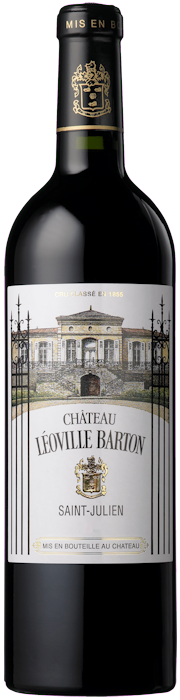
CHÂTEAU LÉOVILLE BARTON
2012 2ème Cru Classé Saint Julien
83% Cabernet Sauvignon, 15% Merlot, 2% Cabernet Franc. Fresh but subdued nose, compact to start but there is spice, and depth in the density of fruit on the mid-palate. Dense tannins too, but the succulence holds sway. Long as the flavour-filled tannins melt and unravel. It is as always a wine that requires a certain patience. From 2025. Rating: 92 L&S (Apr 2013)
* This is a pre-shipment/primeur offer. All orders are accepted under the TERMS of this offer which differ from the terms of the rest of the site.
The 2012 Léoville-Barton has a touch more precision and drive compared to 2012 Langoa-Barton, blackberry and raspberry, cedar and mint, almost Pauillac in style. The palate is medium-bodied with sappy black fruit, quite feisty and vibrant with good concentration on the finish. This is quite a serious Saint-Julien, and it has the substance to age well in bottle. Excellent. Tasted twice at Bordeaux Index's Ten Year-On tasting and blind at the Southwold Ten-Year On tasting. Drinking range: 2023 - 2040 Rating: 93 Neal Martin, www.vinous.com (Sept 2022)
As with most of these St Juliens, the colour is medium intensity ruby with lovely reflective pools. Sweet notes of smoked caramel, graphite and campfire stealing in along blackberry and cassis fruits. Overall the fruit register is dark, with tannins that are perfectly integrated but still present, confident and holding the fruit in place. The same sappy saline minerality that I found in the Gruaud Larose, not generous but enticing. 60% new oak, 32hm/h yield. Rating: 95 Jane Anson, www.janeanson.com (Mar 2022)
Tasted blind. Sappy. Aromatic, even a bit racy on the nose! Very clever winemaking almost disguises the lack of ripe fruit. Solid, spicy, something to chew on. A wine with some potential and well-managed tannins. Drinking range: 2022 - 2035 Rating: 17 Jancis Robinson OBE MW - www.JancisRobinson.com (Feb 2016)
The 2012 Leoville-Barton is laced with dark red and blue-fleshed stone fruits, spices, sweet spice, mint and licorice. This is a decidedly understated, forward Leoville-Barton that will drink well with minimal cellaring. The classic Leoville-Barton signatures aren't fully developed. Perhaps I caught the 2012 in an awkward stage, but today the wine is quite introspective and gives the impression of not being fully formed. Drinking range: 2017 - 2027 Rating: 91+ Antonio Galloni, www.vinous.com (Jan 2016)
Dense ruby/purple, with cassis licorice and forest floors notes in the aromatics, Léoville-Barton’s 2012 is a relatively big, rich, masculine style of wine. This full-bodied wine needs 5-8 years of cellaring and should evolve easily for 25-30 years. Drinking range: 2023 - 2053 Rating: 92 Robert Parker, The Wine Advocate, www.RobertParker.com (Apr 2015)
The fruit on the nose is deep and brooding and although the palate has a nice weight of fruit the mid palate is quite lean lacking richness and depth. Towards the back ripe cassis does give a little more weight but the finish is lacking in intensity. 2020-30 Rating: 87-90 Derek Smedley MW, www.dereksmedleymw.co.uk (Dec 2013)
The Grand Vin is a blend of 83% Cabernet Sauvignon, 15% Merlot and 2% Cabernet Franc picked between 3 and 15 October at 32hl/ha. It is more introspective than the Langoa at this early stage, but perhaps more complex with subtle tertiary and pencil lead scents infusing the black fruit profile. The palate is superbly balanced with fine tannins, delineated black and red fruit infused with graphite borrowed north from Pauillac. It exudes focus and precision and should be one of the finest Saint Julien 2012s. Rating: 93-95 Neal Martin, www.vinous.com (May 2013)
Dark ruby. Delicately smoky nuances complement dark plum and fresh blackcurrant on the subdued nose. Lively flavors of red cherry, violet, minerals and bitter chocolate show less fat but more cut than those of the Langoa Barton, with a slightly edgy quality to the wine's acidity. The moderately long finish comes across as a little tart today. I did not find the usual ripeness of Leoville Barton. Rating: 88-90 Ian d'Agata, www.vinousmedia.com (May 2013)
Rating: 90 Tim Atkin MW, www.timatkin.com (Apr 2013)
Dense black-red, firm, quite spicy Cabernet Sauvignon, both ripeness and firmness is there, elegance over power and a good future. Drink: 2017 - 2035. Rating: 17.75 Steven Spurrier (Apr 2013)
Small crop and quite extracted this is a rich, dark Barton but there is admirable freshness & crunch, too. Rating: 18 Matthew Jukes www.matthewjukes.com (Apr 2013)
Tight, with an iron spine driving through the red currant, steeped cherry and blackberry core. The toast emerges on the finish, showing well-integrated briary grip. Features solid stuffing for the vintage. Rating: 90-93 James Molesworth, The Wine Spectator (Apr 2013)
Château Léoville Barton
Saint Julien Deuxième Cru Classé 1855
The story of the Irish Bartons in Bordeaux started as early as 1725, when Thomas Barton arrived in Bordeaux. Thomas worked as a merchant, mostly investing his gains in Ireland, as at the time property of foreigners was forfeit to the French crown on the owner’s death – but he did own Château le Boscq in Saint Estèphe at one point. When ‘French Tom’ died at the grand age of 85 in 1780, all his property went to his son William, who was clearly a more difficult character. The wine business was handed to William’s fourth son Hugh, as the older brothers all inherited estates in Ireland. Hugh took on, in 1786 at the age of 20, a wine business turning over £2.5M. Having married Anna Johnston, the daughter of another Anglo-Irish family in Bordeaux, he managed it effectively until he as his wife were thrown into prison in 1793 during the revolution. Hugh and Anna were unexpectedly freed later that year. As their assets had been seized, and presumably fearing for their lives, they moved back to England and Ireland, although keeping close ties with Bordeaux. The company continued to flourish despite all this, and in 1821 Hugh was able to buy Château Pontet Langlois, which he renamed Langoa Barton. Shortly after, in 1826, he also bought a part of the Léoville estate, which became Léoville Barton. Hugh's original intention, so it is said, in purchasing a portion of the Léoville estate was to sell it back to the Marquis de Las-Cases-Beauvoir who had fled France during the Revolution. The Léoville estate had been seized with an eye to selling it off, but in the end only Hugh’s quarter of it was sold and when the emigré Marquis returned without sufficient means to buy it back, Hugh’s part stayed with the Barton family, becoming Château Léoville Barton. Hugh also bought land in Kildare county and built Straffan House, where Anthony Barton was born in 1930.
The Bartons continued to live mostly in England and Ireland until Ronald Barton arrived in Bordeaux in 1924. Ronald’s father had bought out his cousins, so Ronald inherited the whole of both properties, and he was keenly interested in the vineyards and wines. His career was interrupted by the war, and there was much to do to bring the property back to good order after it, but the success of some of the great vintages of the post-war period like 1948, 1949, 1953, 1955 and 1959 are monuments to what he achieved. Ronald handed over the two Châteaux to his nephew Anthony in 1983, three years before his death.
Anthony worked for the merchant company, Barton & Guestier, which had been bought by Seagram, until 1967. After that he started his own company ‘Les Vins Fins Anthony Barton’ – it was only in 1986 that he and his Danish wife Eva were able to move into Langoa and he was able to devote himself to the vineyards. Anthony’s daughter, Lilian Barton-Sartorius, joined him in the merchant business in 1978, sharing and finally taking over the responsibility for the properties too, and in turn her children, Mélanie, the first oenologist in the family, and Damien, (who completed a short stage at the great commercial finishing school of Lea & Sandeman), have joined her. Mélanie is the technical director of the family’s third Médoc property, Château Mauvesin Barton.
The 50 hectare vineyard of Léoville Barton is on one of the most beautiful deep banks of Pyrenean gravels in the Médoc, part of the bank that is closest to the Gironde, continuing southward from Las Cases and Poyferré, with Ducru Beaucaillou beyond, which gives it a free-draining upper layer over a clay base which is good for retaining moisture in the driest conditions. It is planted with 74% Cabernet Sauvignon, 23% Merlot and 3% Cabernet Franc, and managed to retain a high proportion of old vines. It was classified as a 2nd Grand Cru Classé on 1855, when it was already owned by the Bartons, making the family one of the oldest continuous owners in the Médoc (with the Rothchilds at Mouton).
Please make sure that you have read the terms of this offer which are different from those of the main website. If you are unclear as to what is involved in primeur purchases please do call us, but see the 'practical notes' below.
Ordering
Prices are per case as listed 'in bond London'.
Pre-Orders are a firm commitment from you to buy the wines you order on release, subject to the price being below the upper price of the estimated band on our website. You may also set your own upper price limit, lower or higher than ours. Pre-orders will be fulfilled subject to availability. Providing this firm commitment to us effectively gives you priority.
Wines listed on the website (after any pre-orders and allocations have been fulfilled) can be ordered in the usual way via the website order form or by email or telephone 020 7221 1982, always subject to stock remaining.
Confirmation
All orders will be confirmed by email and are contractually binding unless written cancellation is received within seven days of the confirmation date, apart from pre-orders which are binding if the release price is below the top estimate or other price you have set.
Invoices are raised at the In Bond price, excluding any duty and VAT which will become payable at the prevailing rates on arrival of the wine if required duty paid.
Payment is required on sight of invoice, by cash, cheque, debit card or credit transfer. We reserve the right to charge 2% per month on invoices unpaid after 30 days.
Delivery
- Shipment to our bond (LCB Creek Road) and insurance are included in the in bond price.
- Delivery is free to Lea and Sandeman / Elephant storage accounts, both duty paid and in bond.
- Other deliveries (In Bond and Duty Paid) are also free subject to a minimum order from the offer of £1000, orders below this total will be charged £16.50+ VAT when the wine invoices are issued. We will group deliveries and this is a charge for your entire purchases, not a per-case charge.
- Delivery for 2016 Bordeaux primeurs will probably be completed by October 2019, but we make no guarantee as to specific delivery times, and some of the Sauternes may be later.
Practical notes - how it works
We start a sale in each customer's name and add all their primeur orders to one sale which is invoiced at the end of the campaign (or when the customer wishes) for immediate payment. We and our customers find that having a single invoice for the vintage is the simpler option, but do please note that confirmed orders are still binding as above even if the final invoice has not been issued.
When the wine is shipped, unless previously specified we will assume that delivery is to be to bonded storage with Elephant Storage, but in any case, we will contact you requesting any alternative instructions. If you have another bonded delivery address you would like the wine to go to, please tell us at the time of ordering. If the wines are required duty-paid we will issue invoices at the rates prevailing at the time for the excise duty (currently £25.98 per case) and the VAT (currently at 20%) on the total of the wine cost and the duty.
Half-bottles, Magnums and larger bottles.
One of the additional advantages of buying en primeur is being able to order the wine in the bottle size you want. Even if a wine is only listed in one size, you can order any bottle or case size you want if the property supplies it, but you must order the case/bottle size you require and check that the correct size has been invoiced.
Additional charges are as follows:-
- +£15 per case of 24 half-bottles
- +£15 per case of 6 Magnums (2 bottles equivalent, 1.5 litres each)
- +£35 per individually boxed Double Magnum (4 bottles equivalent, 3 litres)
- +£45 per individually boxed Imperial (8 bottles equivalent, 6 litres) for Salmanazars, Balthazars, Nebuchadnezzars and Melchiors please enquire for availability and price.