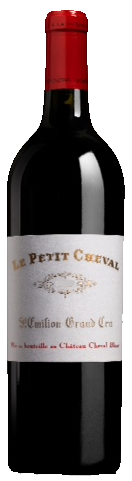
PETIT CHEVAL
2013 Grand Cru Saint Emilion Château Cheval Blanc
There is no Quinault l'Enclos this year as it was hailed completely, so the tasting at Cheval Blanc kicks off with the Petit Cheval. 79% Merlot, 21% Cabernet Franc. 60% new wood. They tried not to force the extraction to retain 'balance and elegance', says Kies van Leuwen. Light and bright in aroma, it actually has good weight, the expression very cool, silky textured, full. Intensity builds subtly to a reasonably long and balanced finish. Rating: 91 L&S (Apr 2014)
* This is a pre-shipment/primeur offer. All orders are accepted under the TERMS of this offer which differ from the terms of the rest of the site.
A one-dimensional, elegant, but unsubstantial effort, this light- to medium-bodied 2013 reveals plummy mocha and black cherry fruit, but not much of it. The wine falls off on the palate, and should be consumed over the next 4-5 years. 2014-2018 Rating: 84-86 Robert Parker, The Wine Advocate, www.RobertParker.com (Aug 2014)
(75% merlot and 25 cabernet franc): Vivid ruby-red. Complex, scented nose is very cabernet franc-dominated, offering delicately spicy blackcurrant, truffle, mint and leafy aromas. Juicy, silky and sweet, with highly nuanced flavors of aromatic herbs and flowers. Not especially dense but wonderfully expressive today, finishing with a firm but polished tannic spine. Pierre Lurton told me that this estate went after only their really ripe cabernet franc and therefore had no issues with dilution. One of the best second wines of the year, this is more successful than many grands vins in 2013. Very well done. Rating: 86-89 Ian d'Agata - Stephen Tanzer website (May 2014)
The nose is sweet fruited and the palate has depth the richness of ripe fruit. Black plum enriches the mid palate the sweet fruit underpinned by freshness and supported by firm but fine tannins. The finish has black fruited richness. 2017-27. Rating: 89-92 Derek Smedley MW, www.dereksmedleymw.co.uk (May 2014)
Only 14% of the crop at Cheval Blanc went into this, the second wine this year. (26% was sold off in bulk.) The sacrifice was worth it, because this is a scented, forward, elegantly framed red with refined tannins, aromatic oak and soft red fruits’ flavours. 2018-22 Rating: 92 Tim Atkin MW, www.timatkin.com (May 2014)
(79 Merlot, 21 Cabernet Franc) 50% new oak, 13.2% alcohol. They apparently sold a lot of bulk wine to keep the standard of LPC up. This is a fresh, bright, clean wine with touches of mint and liquorice and a crunchy, cool, cherry fruit finish. This is a smart wine with a sleek shape and refined tannins. It is a little restrained, but perfectly enjoyable and early drinking too. Rating: 16 Matthew Jukes www.matthewjukes.com (Apr 2014)
Rich and luxurious scent – lots of perfume and succulent fruit. But also a definite green tinge. Light on the palate, with a sour, bitter element. Tannins are under control, though certainly on the rough side. It’s a shame – the scent is charming, but the palate is seemingly suffering from lack of ripeness. (RH) Drink 2015-2019. Rating: 16 Richard Hemming MW - www.JancisRobinson.com (Apr 2014)
79% Merlot. Pretty nose - fresh and fruit-driven. Sweet-fruited attack then smooth, lithe and fresh. Elegant wine with fine tannins but for earlier drinking. Drink: 2017-2025. Rating: 16.5 James Lawther MW, decanter.com (Apr 2014)
Features dusty, cocoa powder edges, with bitter plum, dark cherry and singed alder notes. Persistent, albeit on a small scale. Merlot and Cabernet Franc Rating: 87–90 James Molesworth, The Wine Spectator (Apr 2014)
The Petit Cheval 2013 is a blend of 79% Merlot and 21% Cabernet Franc. It has a higher-toned bouquet than its peers, subtle marine influences coming through with aeration. The palate is medium-bodied with quite bold tannins. Where this wine stumbles it towards the finish that seems very blunt and hard, and consequently the astringency lingers after the wine has exited. Rating: 84-86 Neal Martin, www.vinous.com (Apr 2014)
Château Cheval Blanc
Château Cheval Blanc sits at the pinnacle of the St Emilion meritocracy, unarguably alongside Château Ausone and arguably alongside Château Angélus and Château Pavie, the two estates elevated to Premier Grand Cru Classé (A) status in 2012. But, whilst the other three are clustered around the village of St Emilion, Cheval Blanc is far to the north-west and possibly only a St Emilion by accident of human geography. This is not classic St Emilion limestone and clay territory, Château Cheval Blanc (and neighbouring Figeac) sits on the gravel band that benefits its northerly neighbours across the road and across the border in Pomerol, namely Château Conseillante and Château l’Evangile. Next door Château Figeac was once a mighty estate of some 200ha, but by the early 19th Century the extravagances of the Comtesse de Carle-Trajet had taken their toll and large portions of the estate had to be sold off. Jean-Jacques Ducasse bought a plot of Figeac in 1832, and then a little bit more; his son-in-law, Jean Laussac-Fourcaud bought some more; and by 1871 Château Cheval Blanc had been carved out of the Figeac estate. Initially the wine was still sold as Château Figeac but from 1852 the name Château Cheval Blanc was used. The Laussac-Fourcaud family, morphing into the Fourcaud-Laussac family, owned Cheval Blanc until 1998. With the first classification of St Emilion’s vineyards in 1954, Cheval Blanc and Château Ausone were given special status as Premier Grand Cru Classé (A). New owners in 1998 brought Pierre Lurton in to manage Château Cheval Blanc, something he does alongside managing Château Yquem. A new space-age looking winery was completed in 2011. The 39ha of vineyards are planted to 58% Cabernet Franc and 42% Merlot, with an average age of 40 years. They were augmented by a 1.4ha block added from Château Tour du Pin in 2012. Another block of vines from Tour du Pin appear to be destined for white wine production.
Please make sure that you have read the terms of this offer which are different from those of the main website. If you are unclear as to what is involved in primeur purchases please do call us, but see the 'practical notes' below.
Ordering
Prices are per case as listed 'in bond London'.
Pre-Orders are a firm commitment from you to buy the wines you order on release, subject to the price being below the upper price of the estimated band on our website. You may also set your own upper price limit, lower or higher than ours. Pre-orders will be fulfilled subject to availability. Providing this firm commitment to us effectively gives you priority.
Wines listed on the website (after any pre-orders and allocations have been fulfilled) can be ordered in the usual way via the website order form or by email or telephone 020 7221 1982, always subject to stock remaining.
Confirmation
All orders will be confirmed by email and are contractually binding unless written cancellation is received within seven days of the confirmation date, apart from pre-orders which are binding if the release price is below the top estimate or other price you have set.
Invoices are raised at the In Bond price, excluding any duty and VAT which will become payable at the prevailing rates on arrival of the wine if required duty paid.
Payment is required on sight of invoice, by cash, cheque, debit card or credit transfer. We reserve the right to charge 2% per month on invoices unpaid after 30 days.
Delivery
- Shipment to our bond (LCB Creek Road) and insurance are included in the in bond price.
- Delivery is free to Lea and Sandeman / Elephant storage accounts, both duty paid and in bond.
- Other deliveries (In Bond and Duty Paid) are also free subject to a minimum order from the offer of £1000, orders below this total will be charged £16.50+ VAT when the wine invoices are issued. We will group deliveries and this is a charge for your entire purchases, not a per-case charge.
- Delivery for 2016 Bordeaux primeurs will probably be completed by October 2019, but we make no guarantee as to specific delivery times, and some of the Sauternes may be later.
Practical notes - how it works
We start a sale in each customer's name and add all their primeur orders to one sale which is invoiced at the end of the campaign (or when the customer wishes) for immediate payment. We and our customers find that having a single invoice for the vintage is the simpler option, but do please note that confirmed orders are still binding as above even if the final invoice has not been issued.
When the wine is shipped, unless previously specified we will assume that delivery is to be to bonded storage with Elephant Storage, but in any case, we will contact you requesting any alternative instructions. If you have another bonded delivery address you would like the wine to go to, please tell us at the time of ordering. If the wines are required duty-paid we will issue invoices at the rates prevailing at the time for the excise duty (currently £25.98 per case) and the VAT (currently at 20%) on the total of the wine cost and the duty.
Half-bottles, Magnums and larger bottles.
One of the additional advantages of buying en primeur is being able to order the wine in the bottle size you want. Even if a wine is only listed in one size, you can order any bottle or case size you want if the property supplies it, but you must order the case/bottle size you require and check that the correct size has been invoiced.
Additional charges are as follows:-
- +£15 per case of 24 half-bottles
- +£15 per case of 6 Magnums (2 bottles equivalent, 1.5 litres each)
- +£35 per individually boxed Double Magnum (4 bottles equivalent, 3 litres)
- +£45 per individually boxed Imperial (8 bottles equivalent, 6 litres) for Salmanazars, Balthazars, Nebuchadnezzars and Melchiors please enquire for availability and price.