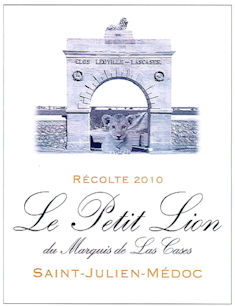
LE PETIT LION
2014 Saint Julien Château Leoville Las Cases
57% Merlot, 38% Cabernet Sauvignon. This is the true second wine of Léoville Las Cases - in that it mimics more closely the blend of the grand Vin and comes from A very distinct vineyard just behind Léoville Poyferré. This is different to the more famous Clos du Marquis which is a brilliant wine in its own right, but a very distinct cuvée from a very distinct vineyard. In the palate it delivers all the fun of a Las Cases, but painted with broader brush-strokes. Although less-delineated and complex there is lovely classic St Julien note of pencil lead and graphite, framing dark, svelte crunchy berry fruit. This is elegant, but has some serious stylish push to it. Drinking range: 2020 - 2025 Rating: 91 L&S (Apr 2015)
* This is a pre-shipment/primeur offer. All orders are accepted under the TERMS of this offer which differ from the terms of the rest of the site.
The 2014 Le Petit Lion has a tightly wound bouquet: blackberry and briary, pencil lead with a whiff of smoke. The palate is medium-bodied with sappy red berry fruit, easy-going in style but there is commendable depth here, nicely balanced with just a subtle tang of spice towards the finish. Tasted blind at the annual Southwold tasting. Drinking range: 2018 - 2025 Rating: 87 Neal Martin, www.vinous.com (Mar 2018)
Neutral, putty nose and then very severe dry palate without any obvious ripeness and charm. May develop into something much more pleasing. Sour end. Drinking range: 2024 - 2034 Rating: 16 Jancis Robinson OBE MW - www.JancisRobinson.com (Feb 2018)
The 2014 Le Petit Lion retains that earthy bouquet that I remarked upon when I tasted this Deuxième Vin from barrel. Tightly wound black fruit, mixed with a hint of shucked oyster shell surfaces from the glass. The palate is well balanced with supple tannin, well-judged acidity, an almost sorbet-like freshness with touches of blood orange tincturing the slightly tart, but pleasing finish. This has turned out admirably in bottle. Drinking range: 2018 - 2026 Rating: 88 Neal Martin, www.vinous.com (Mar 2017)
The 2014 Le Petit Lion du Marquis de las Cases is soft, slender and very pretty. Crème de cassis, violet, dark spice and menthol are nicely delineated in this attractive, midweight Saint-Julien. The 2014 is a very pure, if somewhat compact, expression of this great estate. Drinking range: 2019 - 2029 Rating: 91 Antonio Galloni, www.vinous.com (Feb 2017)
Young vines plus old Merlot from Las Cases. 57% Merlot. Silky sweet. Polished and forward. Very glamorous. Great for an airline? GV (Good Value)? Drinking range: 2018 - 2025 Rating: 16.5 Jancis Robinson OBE MW - www.JancisRobinson.com (May 2015)
Pure and well-cut, with a beam of unadorned red currant and cherry fruit coursing along, carried by a mouthwatering iron note. Rating: 89-92 James Molesworth, The Wine Spectator (May 2015)
57% old-vine Merlot gives this wine good floral fruit and lengthy, firm finish. Drink: 2018-2024 Drinking range: 2018 - 2024 Rating: 17.5 Decanter Magazine (Apr 2015)
The second wine of Léoville-Las-Cases has a comparatively high percentage of Merlot, which may help to explain the 14% plus alcohol. It's gloriously aromatic and supple, with less backbone than the grand vin, reflecting the younger vines. Smoky, textured and appealing, even at this young age. (One of Tim's Top 10 Second Wines.) Drinking range: 2019 - 2028 Rating: 93 Tim Atkin MW, www.timatkin.com (Mar 2015)
Rating: 91 James Suckling, www.jamessuckling.com (Mar 2015)
Château Léoville Las Cases
St Julien Deuxième cru 1855 One of the leading "super-seconds" - a second growth chateau who's wines rival, in terms of quality and often price, the fabled First Growths of the Haut-Médoc. Before the Revolution, the Leoville estate was one of the largest and grandest in the region. At the time, it was in the aristrocratic ownership of the family of the Marquis de Las-Cases-Beauvoir. Unsurprisingly, the Marquis had to flee. To avoid Leoville being seized, the family decided to sell up but the complicated ownership of the estate, which was split between siblings, prevented the sale of Leoville as a whole and, in the end, only a small portion was sold off, to Hugh Barton, and this became Château Leoville Barton. The remainder of the estate came back to the Marquis' family when his son, Pierre-Jean, inherited most of Leoville, the only exception being a small portion inherited by his sister Jeanne. Jeanne's daughter married Baron Jean-Marie de Poyferré and, in 1840, this portion of the estate sheered off to become Château Leoville Poyferré. To stop further divisions among inheriting children, a holding company was founded to own Château Las Cases. Théophile Skawinski, who managed the estate, bought some shares which later passed to his son-in-law André Delon. The Delon family continued to buy share as they became available until, eventually, they became the owners of Château Leoville Las Cases. The bulk of Las Cases's vineyards - the Grand Clos - sit at the very northern end of St Julien, facing Château Latour across the Ruisseau de Juillac. The vines are planted to 65% Cabernet Sauvignon, 19% Merlot, 13% Cabernet Franc and 3% Petit Verdot. The hand-picked grapes are fermented in an unusual array of wooden, stainless-steel and cement tanks. Wines spend 20 months in oak, with the proportion of new wood for the grand vin varying from 50% to 100% depending on the vintage. Château Leoville Las Cases have one of the most highly regarded "second wines" in Bordeaux - Clos du Marquis. The first vintage was in 1902, long predating most of its competitors. Its status as a true "second wine" is sometimes disputed, as there is a distinct Clos du Marquis vineyard, a little way to the west of the Grand Clos, although the cuvée does include some declassifications from the grand vin and fruit of younger vines. Its status as a "second wine" also belies the quality which exceeds many of the region's "first" wines.
Please make sure that you have read the terms of this offer which are different from those of the main website. If you are unclear as to what is involved in primeur purchases please do call us, but see the 'practical notes' below.
Ordering
Prices are per case as listed 'in bond London'.
Pre-Orders are a firm commitment from you to buy the wines you order on release, subject to the price being below the upper price of the estimated band on our website. You may also set your own upper price limit, lower or higher than ours. Pre-orders will be fulfilled subject to availability. Providing this firm commitment to us effectively gives you priority.
Wines listed on the website (after any pre-orders and allocations have been fulfilled) can be ordered in the usual way via the website order form or by email or telephone 020 7221 1982, always subject to stock remaining.
Confirmation
All orders will be confirmed by email and are contractually binding unless written cancellation is received within seven days of the confirmation date, apart from pre-orders which are binding if the release price is below the top estimate or other price you have set.
Invoices are raised at the In Bond price, excluding any duty and VAT which will become payable at the prevailing rates on arrival of the wine if required duty paid.
Payment is required on sight of invoice, by cash, cheque, debit card or credit transfer. We reserve the right to charge 2% per month on invoices unpaid after 30 days.
Delivery
- Shipment to our bond (LCB Creek Road) and insurance are included in the in bond price.
- Delivery is free to Lea and Sandeman / Elephant storage accounts, both duty paid and in bond.
- Other deliveries (In Bond and Duty Paid) are also free subject to a minimum order from the offer of £1000, orders below this total will be charged £16.50+ VAT when the wine invoices are issued. We will group deliveries and this is a charge for your entire purchases, not a per-case charge.
- Delivery for 2016 Bordeaux primeurs will probably be completed by October 2019, but we make no guarantee as to specific delivery times, and some of the Sauternes may be later.
Practical notes - how it works
We start a sale in each customer's name and add all their primeur orders to one sale which is invoiced at the end of the campaign (or when the customer wishes) for immediate payment. We and our customers find that having a single invoice for the vintage is the simpler option, but do please note that confirmed orders are still binding as above even if the final invoice has not been issued.
When the wine is shipped, unless previously specified we will assume that delivery is to be to bonded storage with Elephant Storage, but in any case, we will contact you requesting any alternative instructions. If you have another bonded delivery address you would like the wine to go to, please tell us at the time of ordering. If the wines are required duty-paid we will issue invoices at the rates prevailing at the time for the excise duty (currently £25.98 per case) and the VAT (currently at 20%) on the total of the wine cost and the duty.
Half-bottles, Magnums and larger bottles.
One of the additional advantages of buying en primeur is being able to order the wine in the bottle size you want. Even if a wine is only listed in one size, you can order any bottle or case size you want if the property supplies it, but you must order the case/bottle size you require and check that the correct size has been invoiced.
Additional charges are as follows:-
- +£15 per case of 24 half-bottles
- +£15 per case of 6 Magnums (2 bottles equivalent, 1.5 litres each)
- +£35 per individually boxed Double Magnum (4 bottles equivalent, 3 litres)
- +£45 per individually boxed Imperial (8 bottles equivalent, 6 litres) for Salmanazars, Balthazars, Nebuchadnezzars and Melchiors please enquire for availability and price.