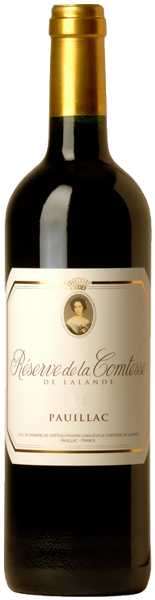
RÉSERVE DE LA COMTESSE
2014 Pauillac
There was an incredibly long harvest at Pichon Lalande - starting on the 16th of September they hung up the secateurs pm the 20th of October. This allowed for each plot to be brought in at the optimum moment. Such a luxurious spell for the pickers has given a fairly impressive wine - full of intense fruit and lovely balance from the ripe, rounded tannins. The lovely weight of fruit at the core of this elegant wine is restarained and charming. THere is a gentle sense of power and push - which continues to the long fisnish. Rating: 92 L&S (Apr 2015)
* This is a pre-shipment/primeur offer. All orders are accepted under the TERMS of this offer which differ from the terms of the rest of the site.
This sneaks into the value category, certainly if you are looking to find a way of getting 1855 classified glamour and brilliance at a more affordable price. It's a wine that we open regularly at home - luscious black fruits, cherry pit and fennel, grippy enough to be a Pauillac but open enough for drinking now. This was the longest harvest on record because they had brought in true plot-by-plot picking at this point, stretching from September 16 to October 14, and the first year in their new cellar. Drinking range: 2024 - 2038 Rating: 94 Jane Anson, Decanter (Dec 2024)
The 2014 Reserve de la Comtesse has a more evolved bouquet with red berry fruit, dried blood and mocha scents, a touch of wild mint emerging with time in the glass. The palate is medium-bodied with softer tannins than its peers, suggesting it is fully mature. It has a lovely smooth, slightly feral finish that will appeal to many, but it lacks a bit of mineralité and precision. Tasted blind at the Southwold 10-Year-On tasting. Drinking range: 2025 - 2044 Rating: 90 Neal Martin, www.vinous.com (Mar 2024)
The 2014 Réserve de la Comtesse has a slightly meaty/dried blood scented bouquet that lacks the delineation and charm of Tourelles de Longueville. The palate is medium-bodied with firm tannin, austere but there is a decent line of acidity and sufficient fruit on the finish to maintain balance. It just lacks excitement and a sense of energy. Tasted blind at the annual Southwold tasting. Drinking range: 2020 - 2032 Rating: 90 Neal Martin, www.vinous.com (Mar 2018)
Very dark crimson. Light, correct, classic nose. Rather loose but lots of ripe fruit even if there is not that much tannin. The Merlot comes through. Very easy to like in the short term. Drinking range: 2021 - 2029 Rating: 16.5 Jancis Robinson OBE MW - www.JancisRobinson.com (Feb 2018)
The 2014 Reserve de La Comtesse is a delicious second wine. Soft, open-knit and caressing, the 2014 offers striking textural depth to balance its dark red/purplish fruit. Spice, tobacco, menthol and licorice wrap around the juicy, super-expressive finish. A burst of aromatic freshness gives the wine its sense of proportion. The Reserve de La Comtesse is one of Bordeaux's most polished second wines, which, among other things, makes it an ideal red to drink over the next decade or so. The blend is 59 % Cabernet Sauvignon and 41 % Merlot. Drinking range: 2017 - 2026 Rating: 92 Antonio Galloni, www.vinous.com (Feb 2017)
The Réserve de la Comtesse 2014 is a blend of 51% Cabernet Sauvignon and 41% Merlot that comes from a selection made in the winery through blind tastings, including 6% vin de presse. It has a tightly-wound, graphite-scented bouquet that would actually suggest a higher proportion of Cabernet Sauvignon then there actually is. The palate is medium-bodied with edgy, chalky tannin on the entry with plenty of dark berry fruit. There is an insistent grip on the finish that does not offer enormous persistence, but you have the sense of coiled-up energy and so it may gain more depth and breadth throughout its élevage. The black pepper note on the aftertaste is an added bonus. Drinking range: 2019 - 2035 Rating: 90-92 Neal Martin, www.vinous.com (May 2015)
The 2014 Reserve de La Comtesse is quite soft and lush in this vintage, in part because of the large presence of Merlot. Dark red cherry, plum, new leather, spices and cloves are super-expressive. Dried flowers, smoke, pencil shavings and dark spices reappear on the open-knit, resonant finish. With time in the glass, the Reserve finds more gracious dimensions of expression, with redder tonalities of fruit intermingled with spice that come forward. I imagine the 2014 will drink well pretty much upon release, as it is already quite open. The blend is 59% Cabernet Sauvignon and 41% Merlot. Rating: 90-92 Antonio Galloni, www.vinous.com (Apr 2015)
Floral, fragrant spring violets the nose has charm the palate bright with red fruit freshness. Ripe cassis fine tannins give mid sweetness but it is lighter at the back with redcurrant freshness and a hint of spice. Drinking range: 2025 - 2036 Rating: 87-89 Derek Smedley MW, www.dereksmedleymw.co.uk (Apr 2015)
After a virtual wipe out in 2013 (there was only 6% in the second wine), the Merlot component is back at a more habitual 41% this year. There's more new oak in this sample than there will be in the finished wine, but it's still plushly fruited and smooth with fine-grained but concentrated tannins and a hint of tangerine. (One of Tim's Top 10 Second Wines.) Drinking range: 2020 - 2028 Rating: 93 Tim Atkin MW, www.timatkin.com (Apr 2015)
There’s a creamy texture to this second wine with tar, blackberry and currant character. Full and integrated with juicy fruits and a long finish. An excellent second wine. Rating: 91-92 James Suckling, www.jamessuckling.com (Apr 2015)
Very deep purple. Great focus and juiciness. Lots of sinew but very glamorous. Pretty damn good for a second wine! Just the dryness and slight shortness on the finish lets it down but the beginning of the tasting experience is wonderful. Drinking range: 2019 - 2030 Rating: 16.5+ Jancis Robinson OBE MW - www.JancisRobinson.com (Mar 2015)
Château Pichon Longueville Comtesse de Lalande
Pauillac Deuxième cru 1855 Facing Château Latour across the road, at the southern end of Pauillac, are the twin Château Pichons. Originally one estate, the two were divided in 1850 on the death of Joseph Pichon. His son Raoul inherited the title of Baron de Longueville and the vineyards of Château Pichon Longueville Baron de Longueville, whilst his daughters inherited the portion that became Château Pichon Longueville Comtesse de Lalande. The only daughter to produce off-spring was Marie-Laure who had married Comte Henri de Lalande in 1818 and it was her descendents, therefore, who shaped the future of Château Pichon Longueville Comtesse de Lalande (or Pichon Comtesse as it is often more conveniently known). The two estates continued to be run as a single vineyard for another ten years, allowing them jointly to be awarded 2nd Growth status in 1855. Pichon Comtesse is now owned by the Rouzard family, owners of the Champagne house of Louis Roederer. Under the ownership of May de Lencquesaing in the final quarter of the 20th Century, the vineyard area of Pichon Comtesse grew from around 40ha to today's 75ha. The vines are 45% Cabernet Sauvignon, 35% Merlot, 12% Cabernet Franc and 8% Petit Verdot. Fermentation takes place in stainless steel, with the wine spending 18 months in wood (50% new). Pichon Comtesse produce one of the most highly regarded second wines - Réserve de la Comtesse (recently renamed Pichon Comtesse La Réserve') - which rivals many other estate's grand vins. The healthy reputation that Château Pichon Longueville Comtesse de Lalande enjoys puts it clearly in the mould of a "super second" - those 2nd Growth estates who's wines merit comparison with the Premier Grand Cru Classés. Pichon Comtesse has had the better of comparisons with its sibling Pichon Baron whose fortunes waned during the 20th Century even if, today, they are on a more equal footing. It is inevitable that the two Pichons will be compared with one another, with Comtesse being a more subtle seductive wine than its slightly foresquare namesake.
Please make sure that you have read the terms of this offer which are different from those of the main website. If you are unclear as to what is involved in primeur purchases please do call us, but see the 'practical notes' below.
Ordering
Prices are per case as listed 'in bond London'.
Pre-Orders are a firm commitment from you to buy the wines you order on release, subject to the price being below the upper price of the estimated band on our website. You may also set your own upper price limit, lower or higher than ours. Pre-orders will be fulfilled subject to availability. Providing this firm commitment to us effectively gives you priority.
Wines listed on the website (after any pre-orders and allocations have been fulfilled) can be ordered in the usual way via the website order form or by email or telephone 020 7221 1982, always subject to stock remaining.
Confirmation
All orders will be confirmed by email and are contractually binding unless written cancellation is received within seven days of the confirmation date, apart from pre-orders which are binding if the release price is below the top estimate or other price you have set.
Invoices are raised at the In Bond price, excluding any duty and VAT which will become payable at the prevailing rates on arrival of the wine if required duty paid.
Payment is required on sight of invoice, by cash, cheque, debit card or credit transfer. We reserve the right to charge 2% per month on invoices unpaid after 30 days.
Delivery
- Shipment to our bond (LCB Creek Road) and insurance are included in the in bond price.
- Delivery is free to Lea and Sandeman / Elephant storage accounts, both duty paid and in bond.
- Other deliveries (In Bond and Duty Paid) are also free subject to a minimum order from the offer of £1000, orders below this total will be charged £16.50+ VAT when the wine invoices are issued. We will group deliveries and this is a charge for your entire purchases, not a per-case charge.
- Delivery for 2016 Bordeaux primeurs will probably be completed by October 2019, but we make no guarantee as to specific delivery times, and some of the Sauternes may be later.
Practical notes - how it works
We start a sale in each customer's name and add all their primeur orders to one sale which is invoiced at the end of the campaign (or when the customer wishes) for immediate payment. We and our customers find that having a single invoice for the vintage is the simpler option, but do please note that confirmed orders are still binding as above even if the final invoice has not been issued.
When the wine is shipped, unless previously specified we will assume that delivery is to be to bonded storage with Elephant Storage, but in any case, we will contact you requesting any alternative instructions. If you have another bonded delivery address you would like the wine to go to, please tell us at the time of ordering. If the wines are required duty-paid we will issue invoices at the rates prevailing at the time for the excise duty (currently £25.98 per case) and the VAT (currently at 20%) on the total of the wine cost and the duty.
Half-bottles, Magnums and larger bottles.
One of the additional advantages of buying en primeur is being able to order the wine in the bottle size you want. Even if a wine is only listed in one size, you can order any bottle or case size you want if the property supplies it, but you must order the case/bottle size you require and check that the correct size has been invoiced.
Additional charges are as follows:-
- +£15 per case of 24 half-bottles
- +£15 per case of 6 Magnums (2 bottles equivalent, 1.5 litres each)
- +£35 per individually boxed Double Magnum (4 bottles equivalent, 3 litres)
- +£45 per individually boxed Imperial (8 bottles equivalent, 6 litres) for Salmanazars, Balthazars, Nebuchadnezzars and Melchiors please enquire for availability and price.