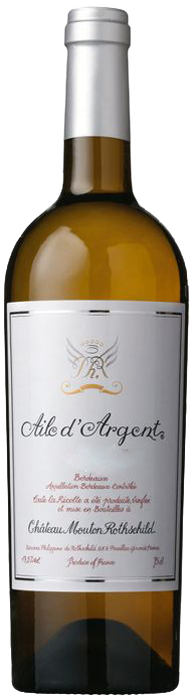
AILE D'ARGENT
2015 Château Mouton Rothschild
The 2015 Aile d'Argent Blanc has a lively, quite fresh bouquet with scents of pear, melon and touches of yellow flowers; there is plenty of energy here. The palate is well balanced with a spicy, lemongrass-tinged opening, not deep or voluminous but displaying a pleasant sharpness toward the finish. Enjoy this over the next decade, or possibly more. Tasted blind at the Southwold 2015 Bordeaux tasting. Drinking range: 2019 - 2028 Rating: 91 Neal Martin, www.vinous.com (Jul 2019)
* This is a pre-shipment/primeur offer. All orders are accepted under the TERMS of this offer which differ from the terms of the rest of the site.
Aromas of dried pineapple and papaya. Mango, too. Full-bodied, focused and tight with a precise, medium-bodied palate and wonderful phenolic tension. Very defined and focused. Extremely long. Just a kiss of oak. Drink now or hold. Drinking range: 2018 - Rating: 97 James Suckling, www.jamessuckling.com (Feb 2018)
The 2015 Aile d'Argent is a very pretty white. As always, the Muscadelle in the blend introduces a slight element of exoticism, but overall, the 2015 is driven by varietal Sauvignon Blanc citrus and floral notes that give the wine brightness and tension. The 2015 is one of the more vibrant vintages of Aile d'Argent I have tasted it. The balance here is simply terrific. Drinking range: 2018 - 2023 Rating: 91 Antonio Galloni, www.vinous.com (Feb 2018)
The 2015 Aile d'Argent Blanc, a blend of 55% Sauvignon Blanc, 43% Sémillon and 2% Muscadelle, has an attractive bouquet of lime cordial, pink grapefruit and apricot that gently unfolds in the glass. The palate is very well balanced with a keen thread of acidity that runs through waxy-textured fresh pear, grapefruit and lime notes. There is just a touch of malolactic fermentation here (actually around 7% of the total according to winemaker Philippe Dhalluin) that just lends cohesion and smoothness to the finish. With a dash of lemongrass loitering on the aftertaste, this is a very fine Aile d'Argent that should age well over the course of a decade, possibly more. Drinking range: 2019 - 2032 Rating: 90-92 Neal Martin, www.vinous.com (Apr 2016)
55% Sauvignon Blanc, 43% Sémillon, 2% Muscadelle. Relatively complex nose. As though this is a wine with a future. I really like the dry finish and nutty layers. Bone dry but lots of interest. Racy but not ready. Drinking range: 2017 - 2024 Rating: 17+ Jancis Robinson OBE MW - www.JancisRobinson.com (Apr 2016)
This has crazy energy with dried pineapple, pear and sliced apple. Full body, exotic and lively long. So exciting. 55% sauvignon 43% semillon and muscadelle. Rating: 96-97 James Suckling, www.jamessuckling.com (Apr 2016)
Château Mouton Rothschild
1855 classification (revised 1973) - Premier Grand Cru Classé The Ségur family, who owned at one time both Lafite and Latour, and had a hand briefly in Haut Brion, also owned Mouton for two years. They sold it to Joseph de Brane in 1720 and the estate was re-christened Brane-Mouton. Unfortunately, it was an estate without a château, the buildings having been sold seperately to Dominique Armailhacq and forming the nucleus of what is today Château d'Armailhac. Under the de Brane family, Mouton steadily gathered a reputation for its wine, with prices nearly equalling the best estates of the day. The de Branes sold Mouton in 1830 and the new owners failed to keep up the previous high standards. In 1853, Brane-Mouton became Mouton-Rothschild when Nathaniel Rothschild purchased the estate, and Mouton-Rothschild started its steady rise to become one of the world's iconic wines. Not iconic enough in 1855 to be granted Premier Grand Cru Classé - a slight described by Baron Phiippe as "the monstrous injustice". It was said that the recent sale of the estate to an Englishman prevented Mouton's recognition among the elite, the truth is probably more complicated. However, the "monstrous injustice" was corrected in 1973 with a unprecedented revision of the 1855 classification raising Château Mouton Rothschild to First Growth status. The Rothschild era at Mouton has seen continuous improvement. Astoundingly, it took until the latter half of the 19th Century for anyone to build an actual château at Mouton-Rothschild when Baron James built the Petit Mouton. An iconic estate deserves an iconic character, and he arrived in 1922 when Baron Philippe de Rothschild toopk over, assuming full ownership in 1947 when he bought out his brothers. A new chais was built and all of the wines were estate bottled, something not common at the time. Baron Philippe bought the neighbouring Château Mouton-Armailhacq in 1933, renaming it Château Mouton Baron Philippe (now Château d'Armailhac). From younger vines of his two estates, Baron Philippe created the popular Bordeaux brand Mouton Cadet. To celebrate the end of WWII, during which time Baron Philippe had had to escape from Vichy imprisonment to join the Free French forces in England, and the German military had taken over Château Mouton Rothschild, the 1945 vintage was bottled with a "V for Victory" label. Thereafter, a new label was designed every year by a contemporary artist, the labels becoming every bit as collectable as the wine. The vineyards sit on a raised mound known as a "motte", from which it is presumed the name Mouton derives. Mouton-Rothschild sits immediately to the south of Lafite. For red wines the 75ha of vineyards are planted to 77% Cabernet Sauvignon, 11% Merlot and 10% Cabernet Franc with a little Petit Verdot. Wines are fermented in barrique and aged for 22 months before bottling. A second wine was introduced in 1993 - Le Petit Mouton with old-fashioned looking label that was designed by Jean Carlu who had designed the Mouton-Rothschild label in use before the War. A small amount of white wine - Aile d'Argent - is produced from mostly Sauvignon Blanc.
Please make sure that you have read the terms of this offer which are different from those of the main website. If you are unclear as to what is involved in primeur purchases please do call us, but see the 'practical notes' below.
Ordering
Prices are per case as listed 'in bond London'.
Pre-Orders are a firm commitment from you to buy the wines you order on release, subject to the price being below the upper price of the estimated band on our website. You may also set your own upper price limit, lower or higher than ours. Pre-orders will be fulfilled subject to availability. Providing this firm commitment to us effectively gives you priority.
Wines listed on the website (after any pre-orders and allocations have been fulfilled) can be ordered in the usual way via the website order form or by email or telephone 020 7221 1982, always subject to stock remaining.
Confirmation
All orders will be confirmed by email and are contractually binding unless written cancellation is received within seven days of the confirmation date, apart from pre-orders which are binding if the release price is below the top estimate or other price you have set.
Invoices are raised at the In Bond price, excluding any duty and VAT which will become payable at the prevailing rates on arrival of the wine if required duty paid.
Payment is required on sight of invoice, by cash, cheque, debit card or credit transfer. We reserve the right to charge 2% per month on invoices unpaid after 30 days.
Delivery
- Shipment to our bond (LCB Creek Road) and insurance are included in the in bond price.
- Delivery is free to Lea and Sandeman / Elephant storage accounts, both duty paid and in bond.
- Other deliveries (In Bond and Duty Paid) are also free subject to a minimum order from the offer of £1000, orders below this total will be charged £16.50+ VAT when the wine invoices are issued. We will group deliveries and this is a charge for your entire purchases, not a per-case charge.
- Delivery for 2016 Bordeaux primeurs will probably be completed by October 2019, but we make no guarantee as to specific delivery times, and some of the Sauternes may be later.
Practical notes - how it works
We start a sale in each customer's name and add all their primeur orders to one sale which is invoiced at the end of the campaign (or when the customer wishes) for immediate payment. We and our customers find that having a single invoice for the vintage is the simpler option, but do please note that confirmed orders are still binding as above even if the final invoice has not been issued.
When the wine is shipped, unless previously specified we will assume that delivery is to be to bonded storage with Elephant Storage, but in any case, we will contact you requesting any alternative instructions. If you have another bonded delivery address you would like the wine to go to, please tell us at the time of ordering. If the wines are required duty-paid we will issue invoices at the rates prevailing at the time for the excise duty (currently £25.98 per case) and the VAT (currently at 20%) on the total of the wine cost and the duty.
Half-bottles, Magnums and larger bottles.
One of the additional advantages of buying en primeur is being able to order the wine in the bottle size you want. Even if a wine is only listed in one size, you can order any bottle or case size you want if the property supplies it, but you must order the case/bottle size you require and check that the correct size has been invoiced.
Additional charges are as follows:-
- +£15 per case of 24 half-bottles
- +£15 per case of 6 Magnums (2 bottles equivalent, 1.5 litres each)
- +£35 per individually boxed Double Magnum (4 bottles equivalent, 3 litres)
- +£45 per individually boxed Imperial (8 bottles equivalent, 6 litres) for Salmanazars, Balthazars, Nebuchadnezzars and Melchiors please enquire for availability and price.