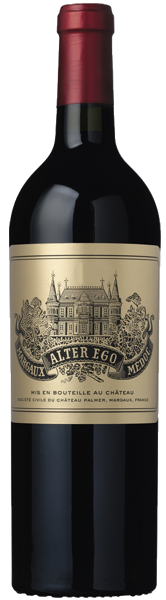
ALTER EGO
2016 du Château Palmer Margaux
48% Cabernet Sauvignon, 40% Merlot, 12% Petit Verdot. Palmer's second wine, Alter Ego was the first in line of a really upbeat tasting at the château. 20% of the crop was lost to mildew which they were powerless against with organic treatments, but what was saved was fabulous in every way. A lovely, fresh, open nose. Very silky textured feel with fresh plum sweetness and rippling weight, then pure ripe black fruit on the finish. Drinking range: 2027 - 2042 Rating: 92-94 L&S (Apr 2017)
* This is a pre-shipment/primeur offer. All orders are accepted under the TERMS of this offer which differ from the terms of the rest of the site.
The 2016 Alter Ego de Palmer has a perfumed bouquet of juicy black fruit, boysenberry jam and light violet aromas. The palate is sweet and chewy on the entry, and quite compact, with firm tannins, leading to a lightly spiced finish. It just misses some excitement and pizzazz compared to its peers. Tasted blind at the Southwold tasting. Drinking range: 2022 - 2035 Rating: 89 Neal Martin, www.vinous.com (Aug 2020)
The 2016 Alter Ego is cut from the same cloth as the grand vin, just less intense, with beautiful cassis fruits, notes of spring flowers, spice, and cedar pencil. A lovely, elegant wine, it has some similarities to the 2010, yet is ever so slightly more elegant, with softer tannins. Drink this beauty any time over the coming 20 years or more. Drinking range: 2019 - 2039 Rating: 93 Jeb Dunnuck, www.jebdunnuck.com (Mar 2019)
The 2016 Alter Ego is a drop-dead gorgeous beauty. Fresh, vibrant and pulsing with energy, the 2016 is utterly captivating from the very first taste. There is a purity to the 2016 that is simply remarkable. Floral overtones add lift to this super-expressive, sensual Margaux. Alter Ego is made from a selection of parcels that are picked earlier than those used for the Grand Vin. Lower temperatures in fermentation and gentle vinifications yield a wine that emphasizes freshness and energy. In that sense, Alter Ego is not really a second wine of the Grand Vin, but rather is more accurately described as a second, and independent, wine off the property. Drinking range: 2022 - 2026 Rating: 94 Antonio Galloni, www.vinous.com (Jan 2019)
The 2016 Alter Ego de Palmer is a blend of 40% Merlot, 48% Cabernet Sauvignon and 12% Petit Verdot this year (a little less Merlot than usual). That exuberant Merlot drives the aromatics along, almost citrus-like with scents of blood orange and blueberries soaring from the glass. The palate is medium-bodied with grainy tannin on the entry, quite sharp acidity at first, quite structured for an Alter Ego with a grippy finish. I think the new oak will bind this together, this sample coming from a used barrel. Drinking range: 2021 - 2036 Rating: 89-91 Neal Martin, www.vinous.com (Apr 2017)
48% Cabernet Sauvignon, 40% Merlot, 12% Petit Verdot. Very bright dark glossy crimson. Very rich and sweet and approachable. Round and fresh. Meaty. Very, very sweet start and then chewy. Lots going on here but not that much tannin, much less than in most other 2016s. Very juicy. Drinking range: 2022 - 2030 Rating: 16.5 Jancis Robinson OBE MW - www.JancisRobinson.com (Apr 2017)
This is very concentrated yet soft and fresh in texture. Full-bodied and round and mouth-filling. So impressive how it fills your mouth yet remains fresh. It’s so framed. Rating: 95-96 James Suckling, www.jamessuckling.com (Apr 2017)
Palmer lost 20% of its crop in the spring, and the Merlot was affected more than the Cabernet so there is only around half as much Alter Ego as normal. The yield here is 29hl/ha, so a lot less than most of Margaux, mainly due to vineyard rebalancing after moving to biodynamics and the spring crop loss. The harvest start date of 3rd October was the latest on record, following on from a very long, slow ripening leading to lots of tannins (71 IPT) which although soft and integrated are at a higher level than 2015, while the 3.65pH remains the same. Late harvests encourage elongated tannins, and Thomas says he has never seen such sophistication in the construction of the wines here, so different from the 2015. As with Palmer, Alter Ego has a highly aromatic nose, majoring here on damson and blackberry. Tasted on an overcast Friday morning and yet it sings, with the most beautifully soft expression of black fruits. It's a different style to others, the 13% ABV being extremely low for this amount of Merlot. Beautiful. Drinking range: 2023 - 2040 Rating: 93 Jane Anson, Decanter (Apr 2017)
The 2016 Alter Ego represents a fairly big departure is style from what has been the norm in recent vintages. Bright red stone fruit, tobacco, flowers and herbs. The combination of less Merlot and naturally lower alcohol are among the factors that have contributed to an especially silky, perfumed Alter Ego built on considerable finesse. Rating: 90-93 Antonio Galloni, www.vinous.com (Apr 2017)
Production of the second wine at Palmer was down to 35% of the total in 2016, reflecting the quality of the vintage. Given the majesty of the Grand Vin, it’s no surprise that this is impressive too: floral fine and well balanced with plum and cassis fruit, nuanced tannins and refreshing acidity. Drinking range: 2020 - 2030 Rating: 93 Tim Atkin MW, www.timatkin.com (Apr 2017)
The 2016 Alter Ego de Palmer has a perfumed bouquet of juicy black fruit, boysenberry jam and light violet aromas. The palate is sweet and chewy on the entry, and quite compact, with firm tannins, leading to a lightly spiced finish. It just misses some excitement and pizzazz compared to its peers. Tasted blind at the Southwold tasting. Drinking range: 2022 - 2035 Rating: 89 Neal Martin, www.vinous.com (Dec 1899)
Château Palmer
Margaux Troisième cru 1855 What is now Château Palmer was originally part of a larger Château d'Issan but was divided among heirs and came into the ownership of the Gascq family in 1748. The widow of the last of the Gascqs, in 1814, and apparently having met him on a stagecoach, sold the estate to an Englishman, General Charles Palmer, and Château de Gascq became Château Palmer. He extended the estate and built quite a reputation for his wines (especially in London) but financial difficulties forced him to sell up in 1843 and, by the time of the 1855 classification, the reputation of Château Palmer had slipped sufficiently to rate "only" 3rd Growth status - a status it has exceded for most of its subsequent history. The present château was built at the end of the 1850's. In 1938 the Société Civile de Château Palmer was formed to take ownership of the estate, with the Sichel and Mähler-Besse families as leading shareholders, a situation which persists to this day. Château Palmer sits between Margaux and Cantenac, just east of Issan. The 55ha of vines are planted to 47% each of Cabernet Sauvignon and Merlot with the balance being Petit Verdot. The Grand Vin spends 21 months in wood (45% new). The second wine is Alter Ego de Château Palmer. In the best years of General Palmer's reign, the wines of Château Palmer were regarded on a par with those of Château Margaux and, indeed, during the worst years of the 1960's Palmer probably had a better reputation. Today, despite huge improvements by its neighbours, Palmer sits very squarely as the leading Margaux estate that isn't actually Château Margaux.
Please make sure that you have read the terms of this offer which are different from those of the main website. If you are unclear as to what is involved in primeur purchases please do call us, but see the 'practical notes' below.
Ordering
Prices are per case as listed 'in bond London'.
Pre-Orders are a firm commitment from you to buy the wines you order on release, subject to the price being below the upper price of the estimated band on our website. You may also set your own upper price limit, lower or higher than ours. Pre-orders will be fulfilled subject to availability. Providing this firm commitment to us effectively gives you priority.
Wines listed on the website (after any pre-orders and allocations have been fulfilled) can be ordered in the usual way via the website order form or by email or telephone 020 7221 1982, always subject to stock remaining.
Confirmation
All orders will be confirmed by email and are contractually binding unless written cancellation is received within seven days of the confirmation date, apart from pre-orders which are binding if the release price is below the top estimate or other price you have set.
Invoices are raised at the In Bond price, excluding any duty and VAT which will become payable at the prevailing rates on arrival of the wine if required duty paid.
Payment is required on sight of invoice, by cash, cheque, debit card or credit transfer. We reserve the right to charge 2% per month on invoices unpaid after 30 days.
Delivery
- Shipment to our bond (LCB Creek Road) and insurance are included in the in bond price.
- Delivery is free to Lea and Sandeman / Elephant storage accounts, both duty paid and in bond.
- Other deliveries (In Bond and Duty Paid) are also free subject to a minimum order from the offer of £1000, orders below this total will be charged £16.50+ VAT when the wine invoices are issued. We will group deliveries and this is a charge for your entire purchases, not a per-case charge.
- Delivery for 2016 Bordeaux primeurs will probably be completed by October 2019, but we make no guarantee as to specific delivery times, and some of the Sauternes may be later.
Practical notes - how it works
We start a sale in each customer's name and add all their primeur orders to one sale which is invoiced at the end of the campaign (or when the customer wishes) for immediate payment. We and our customers find that having a single invoice for the vintage is the simpler option, but do please note that confirmed orders are still binding as above even if the final invoice has not been issued.
When the wine is shipped, unless previously specified we will assume that delivery is to be to bonded storage with Elephant Storage, but in any case, we will contact you requesting any alternative instructions. If you have another bonded delivery address you would like the wine to go to, please tell us at the time of ordering. If the wines are required duty-paid we will issue invoices at the rates prevailing at the time for the excise duty (currently £25.98 per case) and the VAT (currently at 20%) on the total of the wine cost and the duty.
Half-bottles, Magnums and larger bottles.
One of the additional advantages of buying en primeur is being able to order the wine in the bottle size you want. Even if a wine is only listed in one size, you can order any bottle or case size you want if the property supplies it, but you must order the case/bottle size you require and check that the correct size has been invoiced.
Additional charges are as follows:-
- +£15 per case of 24 half-bottles
- +£15 per case of 6 Magnums (2 bottles equivalent, 1.5 litres each)
- +£35 per individually boxed Double Magnum (4 bottles equivalent, 3 litres)
- +£45 per individually boxed Imperial (8 bottles equivalent, 6 litres) for Salmanazars, Balthazars, Nebuchadnezzars and Melchiors please enquire for availability and price.