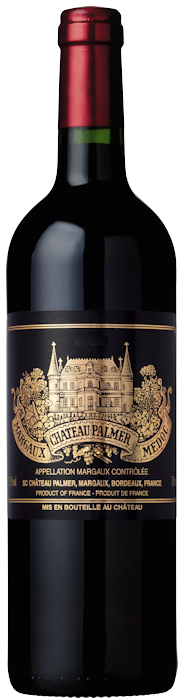
CHÂTEAU PALMER
2016 3ème Cru Classé Margaux
Merlot 47%, Cabernet Sauvignon 47%, Petit Verdot 6%. Lovely delicate dark crimson fruit. Very poised at first. Lots of plum, black fruits and mocha, gently dancing under a very precise, textured layer of structured tannins. A rolling weight. Total harmony and glorious sweet blackberry jus and gourmand richness. It promises to be the best wine produced in this commune in 2016. Drinking range: 2030 - 2050 Rating: 94-96 L&S (Apr 2017)
* This is a pre-shipment/primeur offer. All orders are accepted under the TERMS of this offer which differ from the terms of the rest of the site.
The 2016 Palmer is a brilliant wine from Thomas Duroux, though I feel it will ultimately be surpassed by the 2018. You cannot argue with the nose: intense black cherries and raspberry fruit, crushed violets and crème de cassis (as if there was a touch of Pauillac in there). The palate is medium-bodied with fleshy, sensual tannins, perfect acidity, velvet smooth with layers of chocolate-tinged black fruit, hints of black pepper and cedar towards the sustained finish. It is a fabulous Palmer that will give much pleasure. Tasted at the Palmer vertical at the château. Drinking range: 2022 - 2060 Rating: 98 Neal Martin, www.vinous.com (Aug 2023)
Just hover your nose over the glass to get excited about this wine. Inky purple in colour, cigar box, tobacco bud, pencil lead, tight cassis and bilberry fruit. Where the 2015 is generous, the 2016 is tighter, less expressive at the five year mark, but with layers and potential to fire up an entire room. Has the structure and the chiselled fruit that signposts great Bordeaux in an exceptional vintage, with the nuanced whisper of violet and peony that takes you to the Margaux appellation. Powerful and muscular, still austere but the morieish juice on the finish tells you how much this has to give over the next few decades. Harvest October 3 to 18. Gets better every time you go back to it. 60% new oak. Drinking range: 2026 - 2052 Rating: 100 Jane Anson, Decanter (Dec 2021)
The 2016 Palmer has a generous, slightly lactic bouquet of opulent red fruit infused with touches of dark chocolate, although it calms down and gains more grace with aeration. The palate is medium-bodied with supple tannins and well-judged acidity. Very harmonious, revealing cedar and mint toward the extraordinarily persistent finish. This is another classy, persistent Margaux with a long future ahead. Tasted blind at the Southwold tasting. Drinking range: 2026 - 2070 Rating: 98 Neal Martin, www.vinous.com (Aug 2020)
The finest vintage I’ve ever tasted from this estate, surpassing the 2009 and 2010, the 2016 Château Palmer is a blend of 47% each of Merlot and Cabernet Sauvignon, with the balance Petit Verdot, all of which was brought up in 65% new French oak. This magical effort reveals a saturated purple color as well as a huge nose of crème de cassis, graphite, crushed rocks, and spring flowers, and it develops beautifully with time in the glass. Full-bodied, deep, incredibly concentrated and powerful, it nevertheless just glides over the palate with flawless purity and balance, present, ripe tannins, and a finish that just won’t quit. This is Bordeaux at its most regal and classic. It will be drinkable with just 4-5 years of bottle age and keep for half a century. Drinking range: 2023 - 2073 Rating: 100 Jeb Dunnuck, www.jebdunnuck.com (Feb 2019)
Technical Director Thomas Duroux and his team made one of the most brilliant wines of the 2016 vintage. Palmer is simply exceptional. Rich and dramatically sweeping in the glass, the 2016 is breathtaking. All the elements simply fall into place in a wine of mesmerizing beauty. The counterpoint of dark, sumptuous fruit and floral notes makes for an utterly compelling Palmer that will take its place among the estate's finest vintages. Dark cherry, lavender, spice and mocha are some of the many notes that build into a deep, substantial finish that is truly unforgettable. In a word: magnificent! Drinking range: 2026 - 2066 Rating: 100 Antonio Galloni, www.vinous.com (Jan 2019)
The 2016 Palmer is a blend of 47% Merlot, 47% Cabernet Sauvignon and 6% Petit Verdot cropped at 29 hectoliters per hectare between 3 and 18 October. Matured in 65% new oak (my sample coming from a used barrel), the bouquet is perhaps not quite as intense as some of its peers and takes time to click into fifth gear. Eventually it offers tightly wound blackberry, briary and mineral scents; it is very focused, but maybe less extrovert and more classic in style compared to recent vintages. The palate is medium-bodied with a gentle grip on the entry, quite firm in the mouth with slightly tarry black fruit, hints of black truffle developing towards the finish that feels masculine and linear. It has very impressive length, completing what is an intellectual Palmer, one that I suspect will really blossom in bottle. Drinking range: 2024 - 2055 Rating: 95-97 Neal Martin, www.vinous.com (Apr 2017)
47% Merlot, 47% Cabernet Sauvignon, 6% Petit Verdot. No sulphur dioxide until after MLF. Very dark, velvety look - really bright. Complex and energetic. Not simple and sweet but quite a step change. Feels a little transitional because it's so different and more energetic than the old style. 65% new oak, as always, but the wine can absorb it better. Some bitter chocolate. Lots of sweetness. Energy and freshness. Drinking range: 2025 - 2045 Rating: 17.5+ Jancis Robinson OBE MW - www.JancisRobinson.com (Apr 2017)
I wrote that the 2015 was incredible, and this 2016 is again. It’s equally structured and powerful as the 2015, yet there’s an underlying intellectual serenity to this wine. You taste it, and you want to know and experience it even more. Full and tannic yet ever so polished and beautiful. Mesmerizing. Made from biodynamically grown grapes. Rating: 99-100 James Suckling, www.jamessuckling.com (Apr 2017)
The grand vin represents 65% of production in 2016, the highest ever. It has many similarities in style with the 2001 and 1986, being a classically styled wine full of soft slate, fern, liquorice and cassis, but from the modern era where you can achieve so much more precision. This is a wine that makes you smile from the first sip, and keeps on getting better, caressing you gently across the palate. There is never any let up through the mid-palate, and the biodynamics that have been practised here for the past few years are clearly paying off. Elegant, utterly silky and precise, the structure is just effortless with reasonably fresh alcohols that are the result of late ripening. A perfect example of the appellation, it has the florality, density and slow tannic pace that means it takes you right along with it as the flavours build. The blend is 47% Merlot, 47% Cabernet Sauvignon and 6% Petit Verdot. Intellectual without being overbearing, and built to age. This is impressive stuff. Drinking range: 2027 - 2050 Rating: 98 Jane Anson, Decanter (Apr 2017)
Sophisticated and polished from the outset, the 2016 Palmer is utterly captivating. Dark shades of fruit, accented by hints of smoke, leather and discreet French oak open up in the glass, but it is the wine'e effortless, gracious personality that stands out most. The 2016 literally hovers on the palate with exquisite grace. I can't wait to see how it ages. Rating: 95-98 Antonio Galloni, www.vinous.com (Apr 2017)
Tighter and much more compact at this young age than the 2015 was at the same stage, this is a serious, focused, age worthy Palmer with dense cassis and damson fruit, stylish oak, refined tannins and pithy acidity. “Intellectual,” says Thomas Duroux. Drinking range: 2024 - 2035 Rating: 96 Tim Atkin MW, www.timatkin.com (Apr 2017)
The 2016 Palmer has a generous, slightly lactic bouquet of opulent red fruit infused with touches of dark chocolate, although it calms down and gains more grace with aeration. The palate is medium-bodied with supple tannins and well-judged acidity. Very harmonious, revealing cedar and mint toward the extraordinarily persistent finish. This is another classy, persistent Margaux with a long future ahead. Tasted blind at the Southwold tasting. Drinking range: 2026 - 2070 Rating: 98 Neal Martin, www.vinous.com (Dec 1899)
Château Palmer
Margaux Troisième cru 1855 What is now Château Palmer was originally part of a larger Château d'Issan but was divided among heirs and came into the ownership of the Gascq family in 1748. The widow of the last of the Gascqs, in 1814, and apparently having met him on a stagecoach, sold the estate to an Englishman, General Charles Palmer, and Château de Gascq became Château Palmer. He extended the estate and built quite a reputation for his wines (especially in London) but financial difficulties forced him to sell up in 1843 and, by the time of the 1855 classification, the reputation of Château Palmer had slipped sufficiently to rate "only" 3rd Growth status - a status it has exceded for most of its subsequent history. The present château was built at the end of the 1850's. In 1938 the Société Civile de Château Palmer was formed to take ownership of the estate, with the Sichel and Mähler-Besse families as leading shareholders, a situation which persists to this day. Château Palmer sits between Margaux and Cantenac, just east of Issan. The 55ha of vines are planted to 47% each of Cabernet Sauvignon and Merlot with the balance being Petit Verdot. The Grand Vin spends 21 months in wood (45% new). The second wine is Alter Ego de Château Palmer. In the best years of General Palmer's reign, the wines of Château Palmer were regarded on a par with those of Château Margaux and, indeed, during the worst years of the 1960's Palmer probably had a better reputation. Today, despite huge improvements by its neighbours, Palmer sits very squarely as the leading Margaux estate that isn't actually Château Margaux.
Please make sure that you have read the terms of this offer which are different from those of the main website. If you are unclear as to what is involved in primeur purchases please do call us, but see the 'practical notes' below.
Ordering
Prices are per case as listed 'in bond London'.
Pre-Orders are a firm commitment from you to buy the wines you order on release, subject to the price being below the upper price of the estimated band on our website. You may also set your own upper price limit, lower or higher than ours. Pre-orders will be fulfilled subject to availability. Providing this firm commitment to us effectively gives you priority.
Wines listed on the website (after any pre-orders and allocations have been fulfilled) can be ordered in the usual way via the website order form or by email or telephone 020 7221 1982, always subject to stock remaining.
Confirmation
All orders will be confirmed by email and are contractually binding unless written cancellation is received within seven days of the confirmation date, apart from pre-orders which are binding if the release price is below the top estimate or other price you have set.
Invoices are raised at the In Bond price, excluding any duty and VAT which will become payable at the prevailing rates on arrival of the wine if required duty paid.
Payment is required on sight of invoice, by cash, cheque, debit card or credit transfer. We reserve the right to charge 2% per month on invoices unpaid after 30 days.
Delivery
- Shipment to our bond (LCB Creek Road) and insurance are included in the in bond price.
- Delivery is free to Lea and Sandeman / Elephant storage accounts, both duty paid and in bond.
- Other deliveries (In Bond and Duty Paid) are also free subject to a minimum order from the offer of £1000, orders below this total will be charged £16.50+ VAT when the wine invoices are issued. We will group deliveries and this is a charge for your entire purchases, not a per-case charge.
- Delivery for 2016 Bordeaux primeurs will probably be completed by October 2019, but we make no guarantee as to specific delivery times, and some of the Sauternes may be later.
Practical notes - how it works
We start a sale in each customer's name and add all their primeur orders to one sale which is invoiced at the end of the campaign (or when the customer wishes) for immediate payment. We and our customers find that having a single invoice for the vintage is the simpler option, but do please note that confirmed orders are still binding as above even if the final invoice has not been issued.
When the wine is shipped, unless previously specified we will assume that delivery is to be to bonded storage with Elephant Storage, but in any case, we will contact you requesting any alternative instructions. If you have another bonded delivery address you would like the wine to go to, please tell us at the time of ordering. If the wines are required duty-paid we will issue invoices at the rates prevailing at the time for the excise duty (currently £25.98 per case) and the VAT (currently at 20%) on the total of the wine cost and the duty.
Half-bottles, Magnums and larger bottles.
One of the additional advantages of buying en primeur is being able to order the wine in the bottle size you want. Even if a wine is only listed in one size, you can order any bottle or case size you want if the property supplies it, but you must order the case/bottle size you require and check that the correct size has been invoiced.
Additional charges are as follows:-
- +£15 per case of 24 half-bottles
- +£15 per case of 6 Magnums (2 bottles equivalent, 1.5 litres each)
- +£35 per individually boxed Double Magnum (4 bottles equivalent, 3 litres)
- +£45 per individually boxed Imperial (8 bottles equivalent, 6 litres) for Salmanazars, Balthazars, Nebuchadnezzars and Melchiors please enquire for availability and price.